Raptor Innovation Summit 2026 Content Is Now Available
Explore presentations and insights from this year’s Summit.
Explore presentations and insights from this year’s Summit.

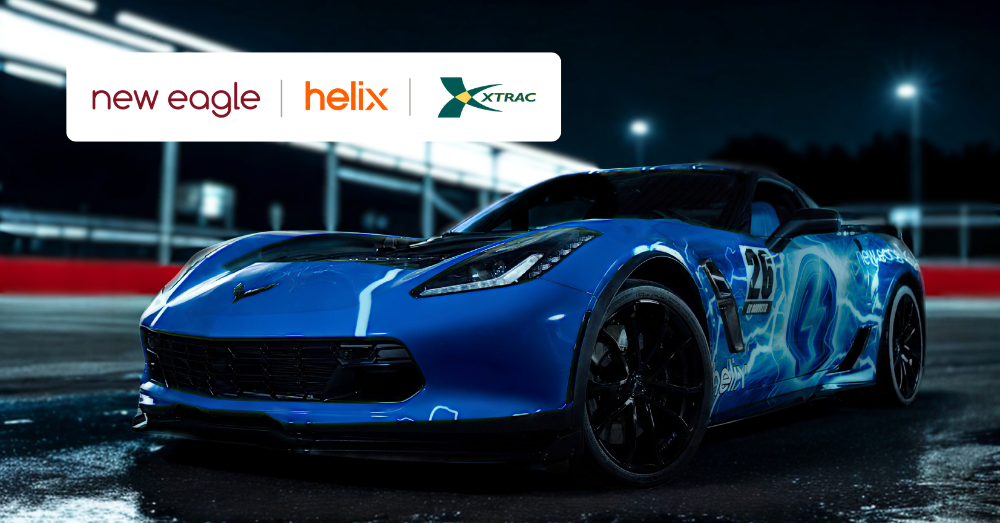
To challenge the limitations of traditional multi-vendor EV development, a new collaboration brings together New Eagle, Helix, and Xtrac in a co-designed, vertically integrated engineering model.
The Electrified C7 Corvette Grand Sport was developed as a high-performance technology demonstrator, validating a drivetrain architecture where propulsion, transmission, and controls were designed together from the outset as a single system. The result is a platform capable of sub-3-second acceleration and 200+ mph performance, delivered in under one year.
The Electrified C7 Corvette Grand Sport is a high-performance electric sports car developed to validate a new model for EV drivetrain development.
Rather than following a traditional supplier structure, the program was executed through a co-design approach between New Eagle, Helix, and Xtrac. From the earliest stages, the three companies worked as a unified engineering team, jointly defining system requirements, performance targets, and operating limits.
This approach enabled propulsion, transmission, and controls to be developed together as a single system, ensuring alignment across mechanical, electrical, and software domains.
The result is not just a demonstrator vehicle, but a production-oriented drivetrain architecture and development model designed to be applied across future programs.
High-performance EV programs are often slowed by integration challenges, not component capability.
In traditional multi-vendor programs, motors, inverters, transmissions, and controls are designed independently, with integration happening late in the process. This fragmented approach introduces misalignment across the system and forces critical issues to be resolved under schedule pressure.
Common challenges include:
These challenges highlight the limitations of developing drivetrain components in isolation.
This collaboration replaces this model with a co-designed approach to drivetrain development.
From day one, New Eagle, Helix, and Xtrac collaborated to design propulsion, transmission, and controls together, aligning all domains to shared system requirements and performance targets.
This eliminated traditional supplier handoffs and allowed the full drivetrain system to be engineered as a cohesive unit rather than a collection of components.
Because these systems were co-designed, torque delivery, thermal limits, and system behavior were aligned early, allowing for system-level validation and significantly reducing iteration later in the program. This approach enabled the team to move from concept to a road-capable demonstrator in less than one year.
This collaborative model was selected for its co-design approach, bringing propulsion, transmission, and controls together as a single, unified system from the outset:
“The collaboration between New Eagle, Helix, and Xtrac shows what’s possible when propulsion, transmission, and controls are designed together from day one. That shift changes everything about how fast and how effectively you can develop an EV.”
The Electrified C7 Corvette Grand Sport demonstrates the impact of a co-designed drivetrain development model:
From concept to demonstrator, the project showcases how co-design between New Eagle, Helix, and Xtrac enables a fundamentally different approach to EV development. By designing propulsion, transmission, and controls together as a single system, the program delivers improved performance, faster timelines, and a scalable foundation for future high-performance electric vehicles.