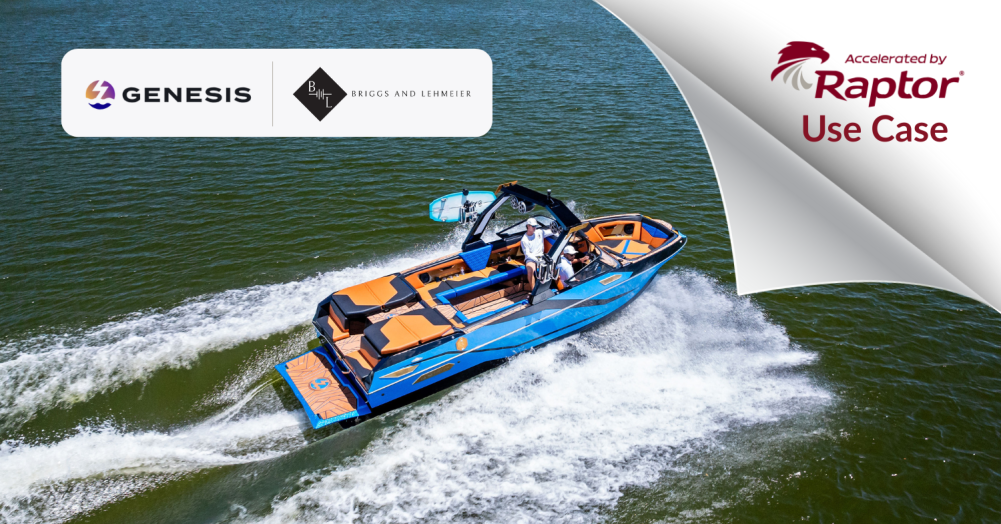
The marine world is used to electrification as a future promise—quiet docks, cleaner lakes, concept boats. The Genesis 24 hybrid wakesurf boat isn’t just something that will be possible someday. It’s running on the water today, delivering silent electric surf sessions, dramatically lower fuel consumption, and all-day runtime without compromising wake quality or performance.
At the center of the Genesis 24 is a hybrid supervisory control system implemented on New Eagle’s RCM80 controller and Raptor® model-based development toolchain. Genesis Marine Technologies partnered with electrification and hybrid powertrain consultants, Briggs & Lehmeier, leveraged the Raptor Platform to enable a complex electrified marine powertrain and to move it quickly from architecture to on-water validation—without sacrificing safety, serviceability.
The Challenge: Electrifying a High-Performance Wakesurf Boat
Premium wakesurf boats are among the most demanding recreational marine platforms. They operate for long hours at steady high loads, require precise torque control to maintain a consistent wake, and are expected to deliver a luxury user experience defined by low noise and vibration.
Traditional V-drive gasoline boats meet these performance demands, but there’s a cost. Daily fuel consumption of 40–50 gallons. Engine noise and vibration. Plus, as engines grow larger and more complex, maintenance needs increase.
Genesis Marine set out to change that equation. Their goal was not simply to add electric assist, but to rethink the propulsion system entirely:
- delivering silent electric surf capability,
- hybrid all-day operation, and
- meaningful reductions in fuel burn and maintenance.
Achieving those goals required more than high-voltage hardware. It demanded a robust supervisory control system capable of safely coordinating electric propulsion, onboard generation, battery management, and multiple operating modes in real-world marine conditions.
Genesis Marine: Defining a Vision
Genesis Marine Technologies approached electrification with a clear product vision. Founded by experienced riders and engineers, the team focused first on the on-water experience: quiet operation, consistent wake quality, and more time riding instead of refueling.
The Genesis 24 is built around the Trident Hybrid™ system—an EV-first, series-hybrid architecture where a high-voltage electric motor drives the propeller, while a compact gasoline auxiliary power unit (APU) acts solely as a range extender. In the current configuration, this role is fulfilled by an Indmar 2.3L EcoBoost engine, though the Trident Hybrid™ architecture is designed to be fully modular. This approach enables electric propulsion as the primary operating mode, with hybrid operation providing extended range beyond battery-only limits.
Before engaging controls and integration partners, Genesis invested heavily in hull and system fundamentals. More than 75 computational fluid dynamics (CFD) iterations were conducted with Siemens to refine hull hydrodynamics and wake performance. Major high-voltage components—including the battery, inverter, motor, and generator—were selected early.
Commercial intent was clear, with dealer strategy, a Southwest Florida-based production plan, and a target of 2026 deliveries already defined. What Genesis needed next was execution: a way to integrate these elements into a cohesive, production-ready system.
System Architecture and Execution by Briggs & Lehmeier
Genesis brought in electrification and hybrid powertrain consultants, Briggs & Lehmeier, to serve as system architect and integrator. With their experience designing and implementing advanced electrified powertrains, Briggs & Lehmeier were tasked with turning Genesis’s vision into an operable, serviceable hybrid platform.
Their scope included defining the full hybrid supervisory architecture, energy management strategy, safety concept, communication networks, and low-voltage systems. Just as important, they approached the program with a production and service mindset from day one—recognizing that marine electrification succeeds or fails on reliability, diagnostics, and long-term support.
Early in the engagement, it became clear that the supervisory control layer would be critical. Coordinating a 400 kW electric drive, a 225 kW range extender, a 105 kWh high-voltage battery, and multiple operator-selectable modes required more than custom code. It required a structured controls platform designed for complex hybrid systems.
Why New Eagle: Selecting the Supervisory Controls Platform
Briggs & Lehmeier selected New Eagle’s RCM-80 controller and Raptor® model-based development platform to implement the Genesis 24’s hybrid supervisory controls. The decision was driven by several key requirements.
Speed. Genesis wanted to see a running boat quickly, without locking themselves into prototype-only software. Raptor’s model-based workflow allowed the team to define state machines, energy strategies, and diagnostics in a structured, repeatable way—enabling rapid iteration from bench testing to on-water validation.
Production readiness. The RCM80 provided a robust, automotive-grade supervisory controller capable of managing complex hybrid logic while supporting ISO-aligned software structure and integrated diagnostics.
Serviceability. From the beginning, the system was designed to support production-grade diagnostic trouble codes, freeze-frame data, and service workflows—avoiding the costly rework that often appears late in electrification programs.
Hybrid System Architecture
At the system level, the Genesis 24 operates as an EV-first, series-hybrid platform. The electric motor delivers up to 400 kW (approximately 530 horsepower and 1,420 lb-ft of torque) directly to the propeller. The gasoline APU never drives the prop mechanically. Instead, it generates electrical power to sustain battery state-of-charge during extended operation.
Using Raptor-Dev, Briggs & Lehmeier implemented a supervisory architecture that manages multiple operating modes, including Pure Electric, Economy, Balanced, and Performance. Each mode defines how aggressively the system draws from the battery, when the APU engages, and how thermal and state-of-charge limits are enforced.
Safety and fault handling were integral to the design. The supervisory logic includes clear derate and limp strategies, coordinated across high- and low-voltage systems. Communication networks and interface contracts were defined early, simplifying integration and reducing downstream risk.
Crucially, wake quality and rider experience were treated as control objectives—not afterthoughts. Seamless transitions between electric and hybrid operation were essential to maintaining a consistent surf wave.
From Bench to Lake: Six Months of Supervisory Development
One of the most striking aspects of the Genesis 24 program was the pace of supervisory controls development. Within approximately six months, the hybrid control logic was implemented, tested, and moved from bench environments to on-water trials.
Raptor enabled rapid iteration, allowing engineers to validate energy strategies and state behavior before hardware was fully integrated. As testing progressed to the lake, the same model-based structure supported calibration and tuning of EV-to-APU transitions, charge-sustaining behavior, and thermal management.
Genesis ultimately progressed through a two-year integration and validation program without accumulating technical debt in the controls layer.
Performance Results on the Water
The result of this system-level approach is a wakesurf boat that delivers both measurable and experiential gains.
In pure electric mode, the Genesis 24 supports up to 90 minutes of silent surf operation while carrying approximately 5,000 lbs of ballast, eliminating engine noise and dramatically reducing vibration. During surf operation in hybrid mode, the APU sustains battery charge, enabling all-day use with typical fuel consumption of just 5–10 gallons per day. Comparable gasoline boats often consume four to five times that amount under similar conditions and operation. Beyond surf use, the Genesis 24 can support multiple hours of electric-only operation under lighter-load cruise conditions for typical transit, without consuming fuel.
Preliminary testing shows noise reductions of up to 75 percent compared to conventional V-drive boats. Just as important, early riders report consistent, premium wake quality across operating modes, with no perceptible transitions during operation.
These outcomes underscore a key lesson for marine electrification: performance gains come from integrated systems and well-executed controls, not from electrification alone.
Validation to Commercialization and a Platform for the Future of Marine Electrification
Today, the Genesis 24 is well beyond the concept stage. Dealer agreements are in place, production planning is underway in a new state of the art manufacturing facility in Southwest Florida, and very limited build slots remain for 2026 deliveries.
For OEMs evaluating electrified marine platforms, this matters. The Genesis 24 demonstrates that hybrid systems can be engineered, validated, and commercialized using production-grade tools and processes—reducing risk while accelerating time to market.
Beyond a single boat, the Genesis program highlights the importance of scalable platforms. The Trident Hybrid™ system is designed to support future Genesis models as well as potential licensing to other OEMs. Standalone range extenders and modular battery configurations extend applicability to commercial and specialty marine applications.
For New Eagle, the project reinforces a broader truth seen across mobility sectors: successful electrification depends on flexible, production-ready controls platforms that bridge the gap between prototype innovation and real-world deployment.
The Path to Production-Ready Marine Electrification Today
The Genesis 24 hybrid wakesurf boat proves that electrification in marine applications is not a distant goal—it is achievable today with the right partners, architecture, and tools. By combining Genesis Marine’s product vision, Briggs & Lehmeier’s system-level execution, and New Eagle’s RCM80 and Raptor platform, the team delivered a hybrid system that performs on the water and scales toward production.
For marine OEMs considering hybrid or electric platforms, the takeaway is clear: the challenge is not whether electrification can work, but whether it can be executed with the rigor required for production. Controls matter—and getting them right early makes all the difference.
If you’re exploring hybrid or electric propulsion for your next platform, New Eagle’s team works with OEMs and integrators to accelerate development while keeping production, safety, and serviceability in focus. Reach out to New Eagle’s experts to discuss how a production-ready controls platform can transform your project and get it on the water—with speed and confidence.