Raptor Innovation Summit 2026 Content Is Now Available
Explore presentations and insights from this year’s Summit.
Explore presentations and insights from this year’s Summit.

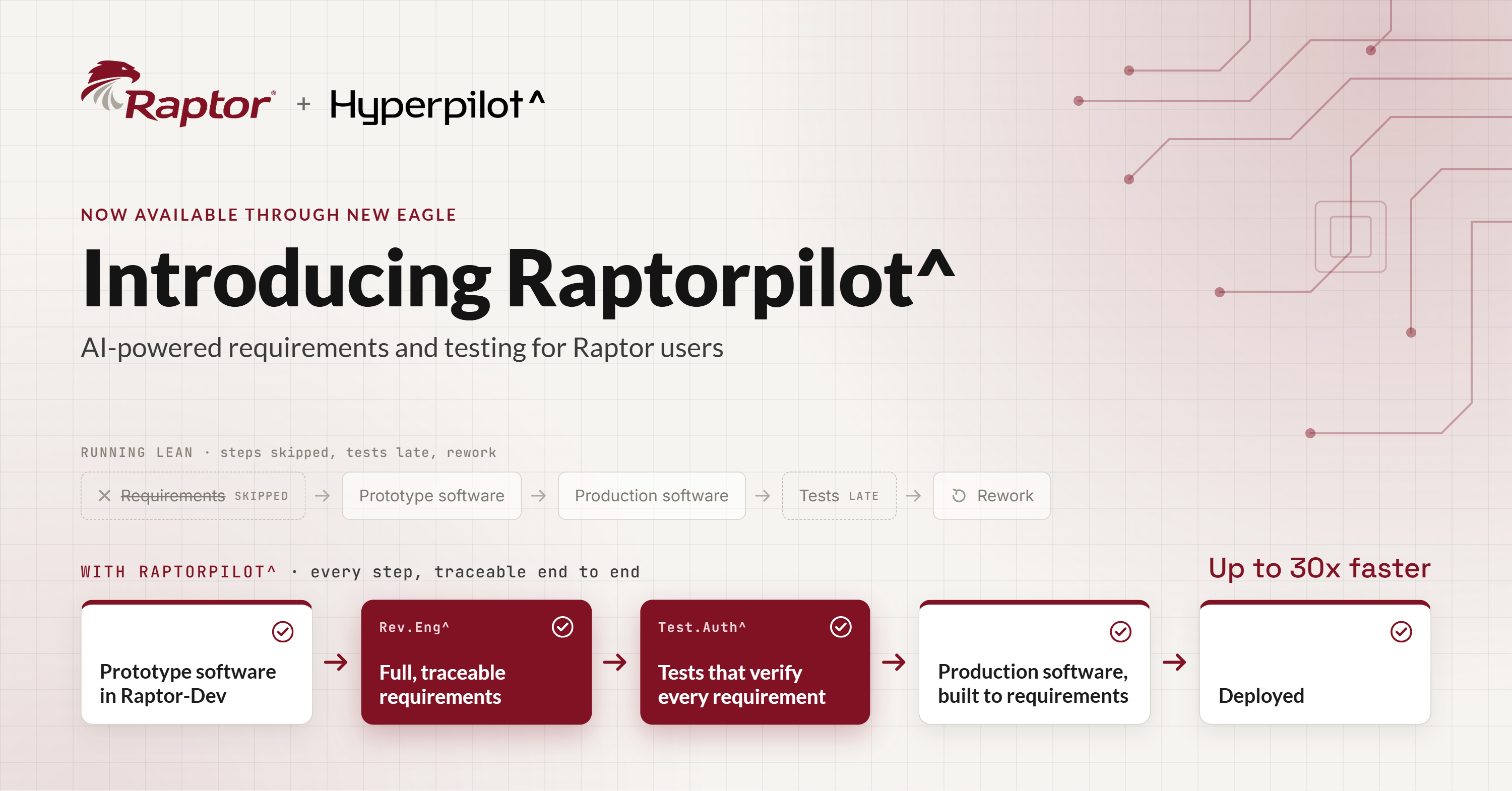
The engineering V-cycle depends on clear connections between system requirements, software development, and verification. Establishing and maintaining those connections require substantial manual effort, particularly as control software evolves. AI-powered engineering tools are now helping automate portions of that process, deriving formal requirements from existing models and code and generating executable tests against them. This allows engineers to spend less time on repetitive authoring tasks and more time developing, evaluating, and refining their systems.
Introduced at the Raptor Innovation Summit 2026, Raptorpilot^ brings these capabilities to the Raptor ecosystem. Powered by Hyperpilot^ Studio and now available through New Eagle, Raptorpilot^ combines automated requirements engineering and executable test generation in a single solution.
For a closer look at the technology, explore the Raptor Innovation Summit presentation by Elie Talj, CEO of Hyperpilot.
Model-based development tools like Raptor enable engineers to build, simulate, and iterate on control software efficiently. As a program matures, however, teams must also establish the documentation and verification structure needed to support production development. For teams working with existing prototypes, this can present a particular challenge. They may have functional models and code but lack the formal requirements, traceability, and tests needed to demonstrate that the software meets its intended objectives.
Creating and maintaining the artifacts manually consumes substantial engineering resources, especially as software continues to evolve. Raptorpilot^ address the gap through two interconnected AI-powered capabilities:
Together, these capabilities create a direct connection between existing Raptor models and code, formal requirements, and executable tests. By automating much of the initial authoring process, Raptorpilot^ allows teams to build on their existing software, reduce repetitive engineering work, and maintain human oversight of the generated requirements and tests.
Raptorpilot^ combines Rev.Eng^ and Test.Auth^ under a single license, supporting requirements engineering and verification within a connected workflow. Together, these capabilities help teams maintain traceability as software and requirements evolve.
Rev.Eng^ analyzes existing Raptor models, Simulink models, or unmodified source code to derive structured, traceable requirements. Engineers can apply the capability at the product, system, subsystem, or component level, generating requirements at the appropriate level of detail for their application.
The generated requirements follow EARS (Easy Approach to Requirements Syntax) principles. Rev.Eng^ can also produce a full traceability matrix and export requirements in Requirements Interchange Format (ReqIF) for use in other engineering tools. These capabilities are particularly valuable for teams working with prototypes or software developed through rapid iteration, where formal requirements may not yet be fully documented.
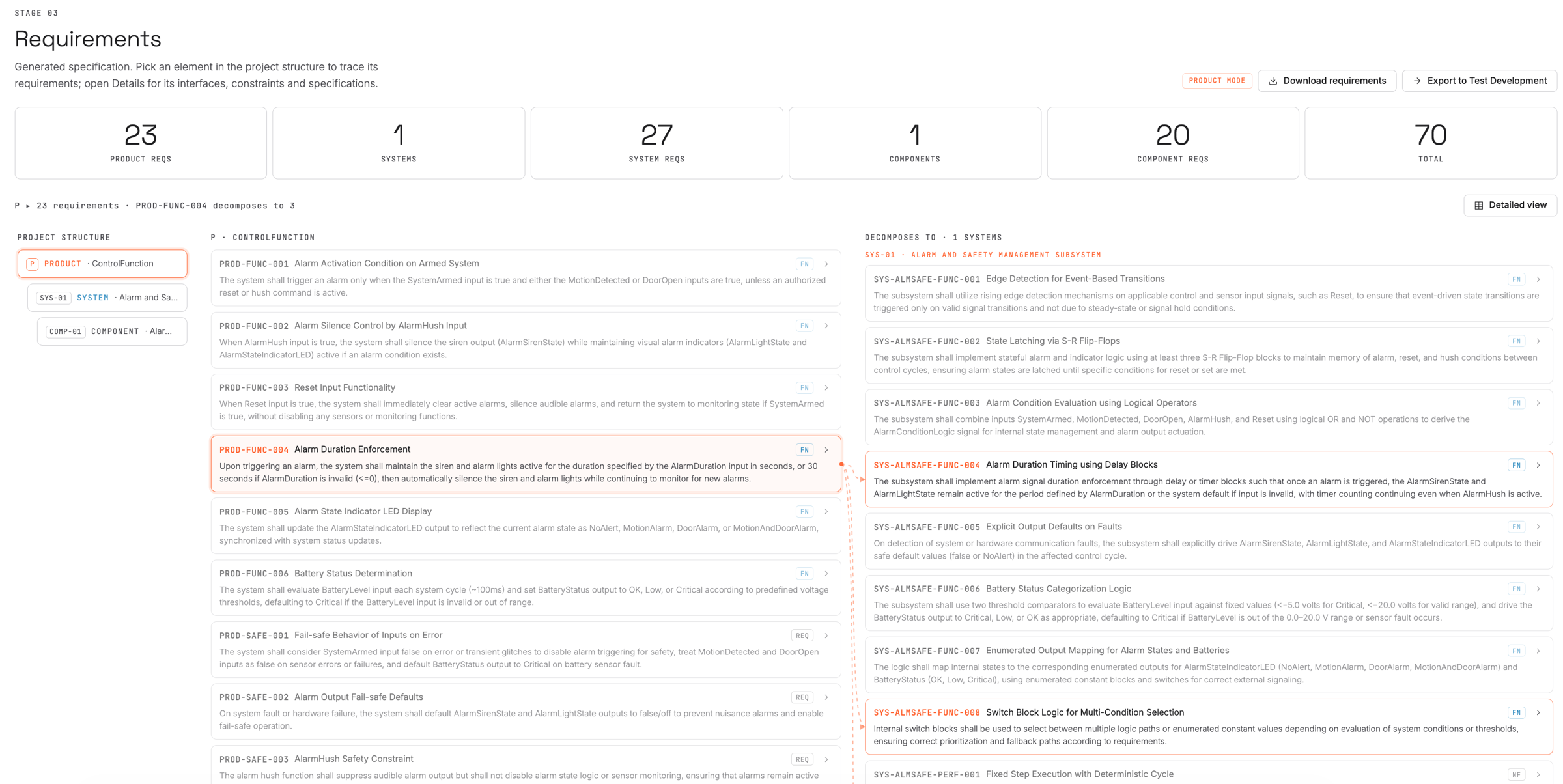
Rev.Eng^ generates product, system, and component requirements from existing code, with each requirement traced to the ones it decomposes into.
Instead of manually reconstructing requirements from existing development work, engineers can use Rev.Eng^ to establish a structured baseline for review and refinement. This reduces the effort involved in initial authoring while keeping engineers responsible for evaluating and approving the generated requirements.
Test.Auth^ extends the workflow by converting requirements—including those generated by Rev.Eng^—into executable tests. Each test remains traceable to the requirement it is intended to verify, helping engineers maintain a clear connection between specifications and verification activities.
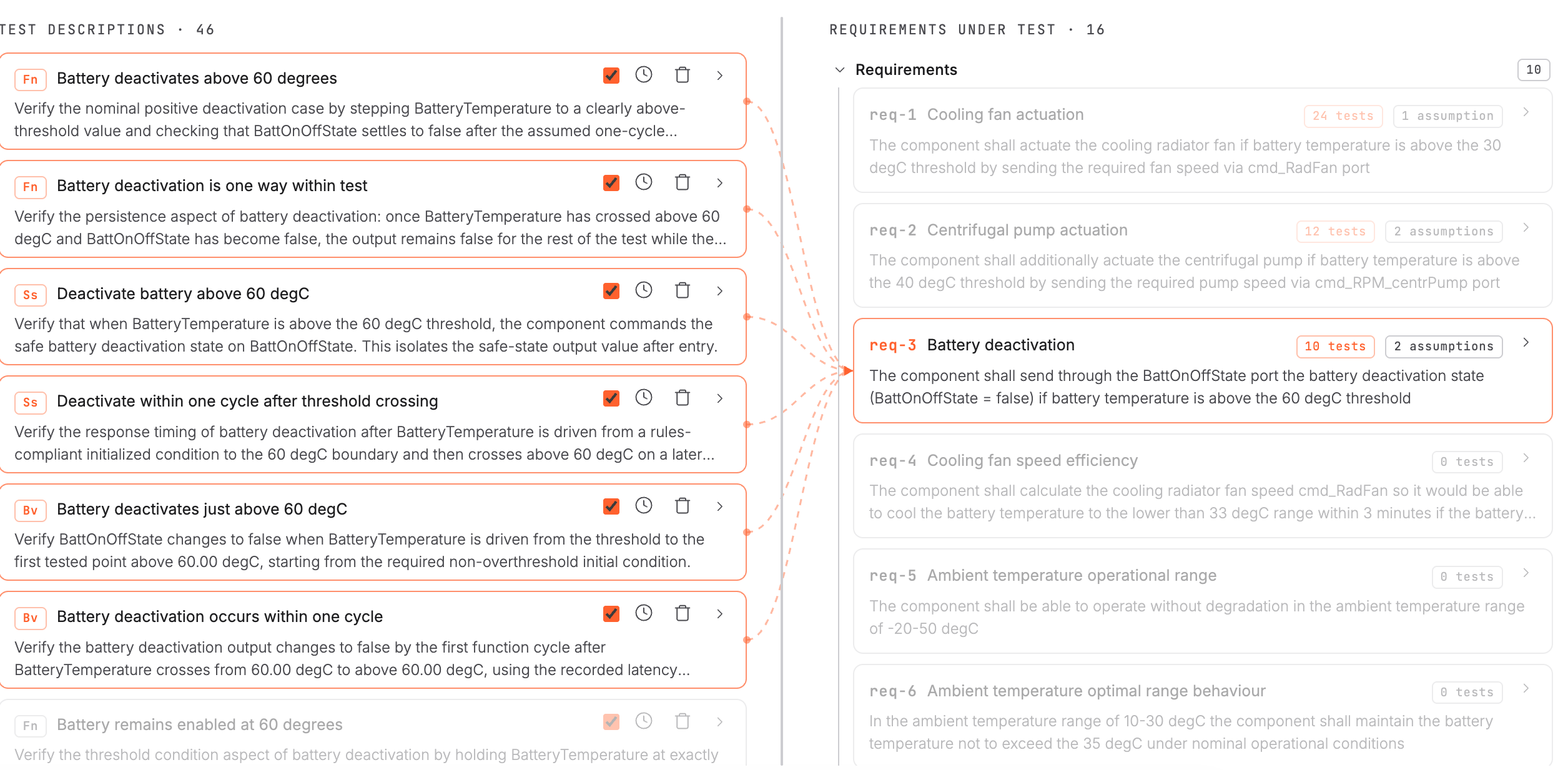
Test.Auth^ generates tests for each requirement and links every test back to the requirement it verifies.
The capability supports up to 100% MC/DC test coverage and can generate tests in native formats for MATLAB Test, C/C++, and Python environments. Unlike tools that produce test descriptions alone, Test.Auth^ generates executable tests that can be used within supported testing environments. Hyperpilot^ has also demonstrated tests authored with Test.Auth^ and executed using Raptor components.
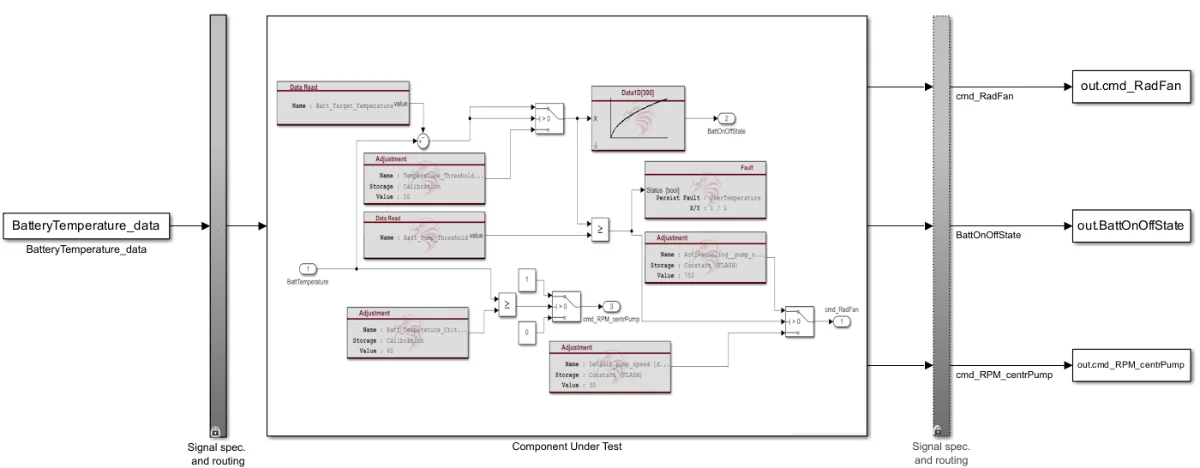
A Raptor model used to run tests authored by Test.Auth^.
As requirements evolve, engineers can regenerate tests to reflect changes, reducing the manual effort required to maintain verification artifacts. This helps teams keep testing aligned with ongoing development while retaining responsibility for reviewing test coverage and validating results.
A recent New Eagle inverter pilot illustrates how AI-powered requirements engineering and test generation can accelerate development. Using Hyperpilot^, a single engineer generated 401 traceable requirements in approximately 16 hours, followed by 2 days of engineering review. Test generation took approximately 1 hour, with an additional week for review.
The complete effort took approximately 1.5 weeks, compared with an estimated 4 months for a conventional requirements and testing workflow.
Because the comparison involved different staffing levels, these results illustrate potential efficiency gains rather than establishing a universal performance benchmark. Hyperpilot^ also reported that 90% of the generated requirements required no modification during review, while none of the generated tests required modification. More broadly, the company has reported up to 30x faster iteration from requirements to fully traceable test generation, including review time.
For Raptor development teams, the benefits extend beyond authoring speed. By connecting requirements engineering and automated testing, Raptorpilot^ can help teams:
Human oversight remains essential throughout this process. Engineers must still assess the generated requirements, review test coverage, and determine whether the verification artifacts adequately represent the intended system behavior.
With Raptorpilot^ now available through New Eagle, Raptor users can extend their existing model-based development workflows into requirements engineering and automated verification. The collaboration with Hyperpilot^ brings new capabilities to the Raptor ecosystem, helping engineering teams move more efficiently from functional software toward production.
Looking ahead, Hyperpilot^ is developing SW.Syn^, a capability that extends automation beyond requirements engineering and verification into the generation of the control software itself. SW.Syn^ is a new kind of AI, not an LLM. Where today’s AI coding assistants need an expert to prompt them, steer them and check every output, SW.Syn^ works from the test suite alone. The tests authored in Test.Auth^ are executed repeatedly throughout the synthesis process, and their results guide the AI to the correct software until every test passes. No prompting, no expert guidance, no starting point and no review of the AI’s work along the way. And because SW.Syn^ is trained across the entire space of possible control algorithms rather than on existing code, it is not limited to reproducing what engineers have already written: it can arrive at control strategies that have never existed, for hardware that has never been controlled before.
As maturity continues, SW.Syn^ offers a glimpse into Hyperpilot’s broader roadmap for connecting requirements, software development, and verification through AI-powered engineering tools. To explore how Raptorpilot^ could support your development workflow, contact New Eagle to learn more.