Raptor Innovation Summit 2026 Content Is Now Available
Explore presentations and insights from this year’s Summit.
Explore presentations and insights from this year’s Summit.

Vehicle safety and autonomous vehicle R&D are moving fast. Expectations are high, timelines are tight, and research teams are under constant pressure to demonstrate progress with limited resources.
The Advanced Power Systems Research Center, or APS LABS, at Michigan Technological University (MTU) has years of experience successfully navigating these challenges. That’s how it has cemented MTU’s strong reputation as a hands-on, industry-engaged partner working across federal, academic, and industry-sponsored programs. As the Lab expanded its portfolio in autonomous and connected vehicle research, one reality became clear: before autonomy could be tested, vehicles had to be controllable, predictable, and safe.
That requirement led APS LABS back to long-standing engineering partner, New Eagle. The relationship predates this specific project by many years, already proven across multiple vehicle programs. Rather than approaching Drive-by-Wire (DBW) as a standalone technology, APS LABS and New Eagle treated it as infrastructure: a reliable foundation that would allow researchers to move faster, scale across vehicles, and focus on autonomy and safety.
This flexible DBW platform supports APS LABS and its partnership with the American Center of Mobility (ACM) by fostering ongoing expansion in vehicle safety and autonomous vehicle research, development, and validation.
Michigan Technological University’s APS LABs is a development and research-driven organization focused on real-world vehicle systems. A partnership with ACM (through which MTU provides on-site engineering and testing services) allows APS LABS to support a mix of federally funded programs, academic research, and industry collaboration. This work spans propulsion, vehicle controls, advanced driver safety systems (ADAS), autonomy, and mobility.
Unlike programs that focus primarily on simulation or theory, APS LABS emphasizes hands-on vehicle development and testing, including executing development in the real-world environment offered at ACM. Research vehicles are routinely modified, instrumented, and validated in real driving environments, creating both opportunity and pressure. Systems must work reliably, safely, and repeatedly across changing platforms.
In recent years, APS LABS has accelerated its engineering, development, and testing efforts in autonomous vehicle research and development. That shift placed the lab in a strong position for funding, visibility, and technical credibility. Demonstrating capability early—and doing so across multiple vehicles—became increasingly important.
APS LABS’ long-standing relationship with New Eagle has grown over the years through multiple projects and evolving technical needs. By the time autonomous vehicle research became a central focus, New Eagle was already a trusted partner with deep familiarity with APS LABS workflows, expectations, and pace.
Autonomous vehicle research depends on far more than algorithms and perception systems. Fundamentally, it requires precise, reliable control of steering, throttle, and braking. This is what provides the foundation for predictable behavior, safe disengagement, and consistent performance across vehicles and scenarios.
Without a robust Drive-by-Wire system in place, APS LABS researchers faced a challenging tradeoff. Engineers would be forced to spend valuable time rebuilding low-level vehicle controls, diverting effort away from autonomy, perception, and decision-making research. At the same time, safety risks would increase and timelines stretch.
For APS LABS, a viable Drive-by-Wire system had to meet several critical requirements. It needed to work across multiple vehicle platforms, support rapid experimentation and iteration, as well as include well-defined safety mechanisms for fallback and manual override. Just as importantly, it needed to be dependable enough that researchers could trust it and move on.
These needs were intensified by external pressures. Federally funded programs came with tight, fixed schedules. Peer institutions were racing toward similar milestones. Demonstrating operational autonomous vehicles early and often was no longer optional.
Drive-by-Wire was not the research objective. It was the bridge between research ideas and real-world testing.
In a research environment, Drive-by-Wire is more than a convenience. It is a force multiplier. By decoupling autonomy development from electro-mechanical vehicle integration, Drive-by-Wire allows research teams to focus on perception, planning, optimization, and decision-making rather than foundational control challenges.
Teams rely on such flexibility because development and research demands are dynamic. One-off solutions that work for a single vehicle or project quickly become technical debt—a dead end.
Equally important is safety. A research environment involves a mix of stakeholders and evolving test scenarios. Reliable control handoff, predictable disengagement behavior, and confidence in the vehicle’s response are essential for maintaining momentum and trust.
For MTU’s APS LABS, Drive-by-Wire was not an optional enhancement. It was the enabling layer that made sustained autonomous vehicle research possible.
APS LABS did not approach Drive-by-Wire as a commodity purchase. They needed a partner who could move quickly, adapt to changing requirements, and provide real engineering support and engagement throughout development.
New Eagle was a clear choice, thanks to a long-standing and trusting relationship extending back to the company’s founding and built through years of collaboration across multiple projects, not just DBW. No other company understood APS LABS’ technical standards, workflows, and pace of development as well.
APS LABS also needed a highly responsive partner. Autonomous research timelines do not always align with product release cycles. New Eagle could engage directly, troubleshoot issues, and keep projects moving rather than simply delivering hardware and stepping away.
Finally, New Eagle’s consultative approach mattered. Rather than offering a rigid, “solution in a box,” New Eagle worked alongside APS LABS engineers, acting as an extension of the team. That partnership mindset reduced friction, which in a research environment can derail the schedule.
“We chose New Eagle because they were a known partner who could move quickly with us and support what we were trying to accomplish, not just deliver hardware,” said Jeff Naber, ACM Powered by MTU partnership lead and Professor of Energy Systems at MTU. Partnering with New Eagle was less about selecting a product and more about continuing a relationship that had already proven its value.
The Drive-by-Wire solution implemented at Michigan Tech was built on New Eagle’s Raptor platform and used as a foundational control layer across multiple research vehicles. It was treated not as a finished system but as an adaptable framework that APS LABS could integrate with its own autonomy stack and third-party tools.
The platform’s flexibility allowed APS LABS to establish a common control architecture across vehicles, reducing rework as projects evolved. As new research needs emerged, the Drive-by-Wire foundation could be extended rather than replaced.
Integration was a central consideration. The system was designed to coexist with APS LABS developed autonomy software and external perception and planning systems, supporting a modular approach to research vehicle development.
Safety remained a priority throughout. Control handoff, manual override, and validation procedures were built into the workflow before autonomy testing began. This ensured that vehicles behaved predictably and that researchers could focus on higher-level experimentation with confidence.
The Drive-by-Wire deployment was shaped by close collaboration between APS LABS and New Eagle engineering teams. Integration, calibration, and troubleshooting were handled jointly, with New Eagle providing hands-on support throughout development.
This collaborative approach helped accelerate timelines and reduce risk. Rather than forcing APS engineers to solve unfamiliar control challenges in isolation, New Eagle’s involvement kept projects moving forward and minimized delays.
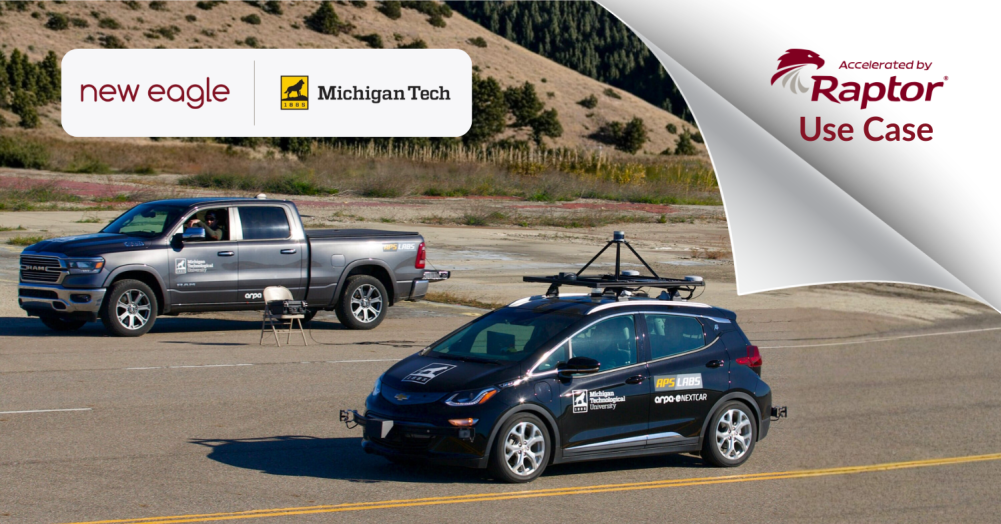
Validation was an ongoing process. Vehicles were tested at ACM’s extensive controlled environments, replicating real-world driving scenarios to establish consistent, repeatable behavior before autonomy features were layered on. This step-by-step approach built confidence in the system and created a stable foundation for more advanced R&D.
This was not a “drop hardware and disappear” engagement. New Eagle remained engaged as APS LABS’ programs evolved, reinforcing the long-term nature of the partnership.
Over multiple projects, Drive-by-Wire was deployed across seven research vehicles shared with ACM, creating a scalable foundation for MTU and ACM, ADAS, and autonomous vehicle work. This allowed the team to bring vehicles online earlier than many peer institutions and to demonstrate multiple vehicles simultaneously rather than sequentially.
The impact went beyond individual projects. By establishing a reusable control architecture, APS LABS reduced technical debt and shortened ramp-up time for new research programs. Vehicles could be adapted more quickly as requirements changed, and lessons learned carried forward instead of being rebuilt from scratch.
Strategically, the Drive-by-Wire foundation has expanded APS LABS’ capabilities, aligning with the growing ACM Powered by MTU partnership. Along with broader autonomous and connected mobility testing, DBW-enabled vehicles now support ADAS white- and black-box assessment, dynamically controlled actors in controlled testing, and remote driving.